
From Prototype to Production
Executive Summary
AI builders such as Lovable, Bolt, v0 and Replit, and coding agents such as Claude Code, Codex and Cursor, can turn an idea into a working application in hours. They optimize for the happy path. Production demands more: an application must survive misuse, failed dependencies and traffic spikes, and stay operable by the engineers who inherit it.
The leading builders now scan for security issues, but the rest of the gap (configuration, reliability, observability, operations, testing and compliance evidence) remains open, and it widens once an application leaves its platform.
Think4Ever Production Hardening closes that gap for any AI-generated codebase. It maps the system's business flows, roles and data, then has one reviewer agent per pillar audit it against a 39-check, nine-pillar checklist, citing the files and lines behind every finding. Fixes are applied by Think4Ever's developer agent only after the user approves its plan, or handed over MCP to the team's own coding agent. The review can be re-run at any time from the app, the REST API or MCP, so later changes are checked again.
The Production Gap Is Wider Than Security
AI-generated applications tend to fall short in nine areas:
| Pillar | Typical gaps |
|---|---|
| Security | Permissive RLS, missing server-side authorization, weak sessions, exposed secrets, no rate limiting or security headers |
| Configuration & Environment | Hardcoded parameters, unvalidated environment variables, configuration drift |
| Reliability & Error Handling | Unhandled exceptions, leaked stack traces, no fallback when dependencies fail |
| Data & Database | No versioned migrations, unbounded connections, missing constraints and indexes, no backups |
| Observability | No structured logging, correlation IDs, error tracking or metrics |
| Performance & Scalability | In-memory state that breaks with multiple instances, unpaginated lists, N+1 queries, slow work in the request cycle |
| Build, Deploy & Operations | Unpinned runtimes, no CI pipeline, root containers with baked-in secrets, no runbook |
| Testing & Quality | Little or no automated test coverage |
| Privacy & Compliance | Unminimized, unencrypted personal data with no deletion path; no audit trail for sensitive actions |
Security is increasingly covered. Lovable, for example, now scans apps before publishing for RLS, database and dependency issues, with opt-in auto-fix and third-party penetration testing. Think4Ever complements these scanners: they cover one platform's stack and its security configuration, not code written with general-purpose agents, exported applications, or the other eight pillars.
How It Works
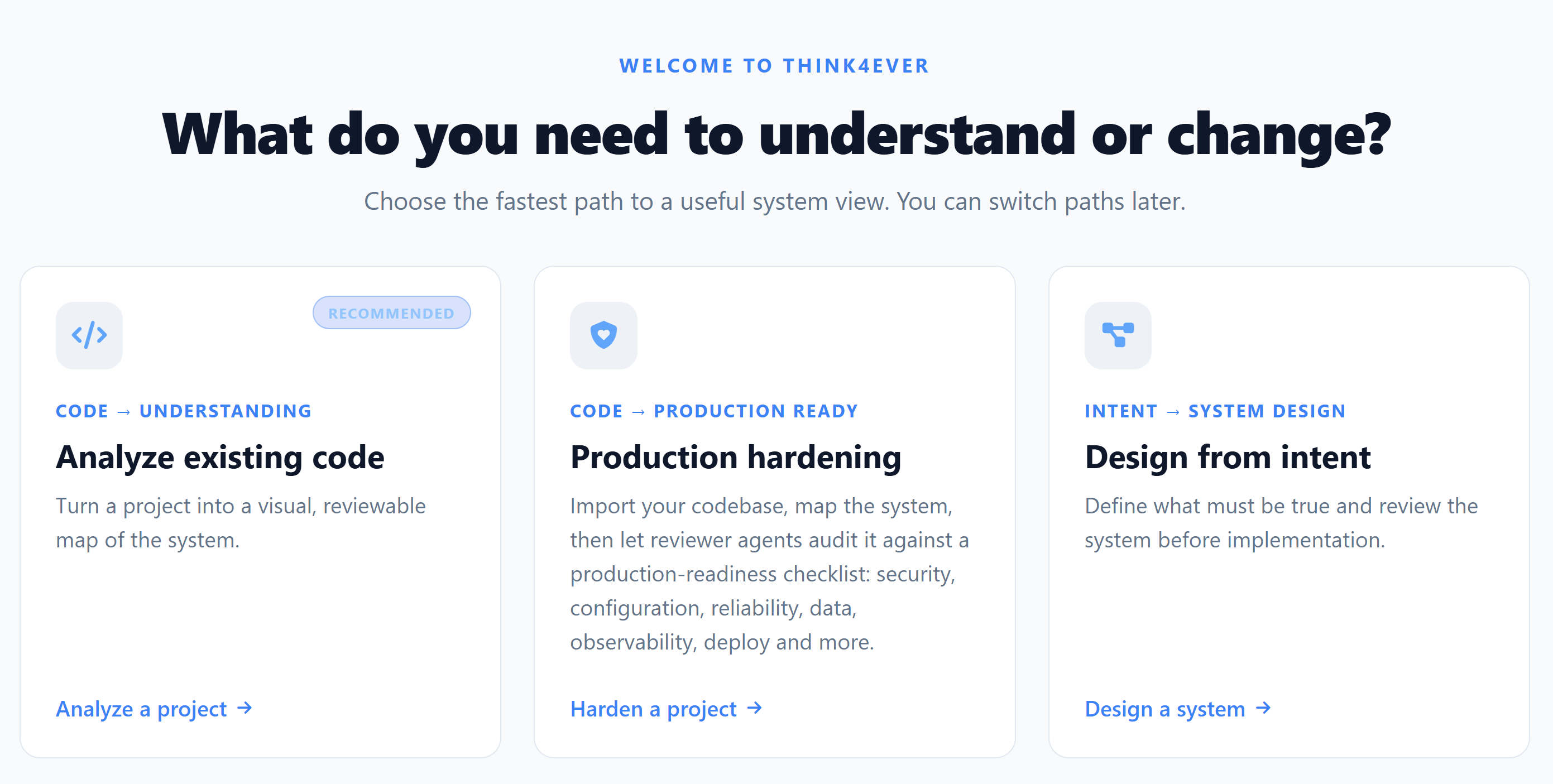
- Import and understand. Import from GitHub, GitLab, Bitbucket, Git, SVN or a Zip file from any source. Think4Ever detects the stack and builds a concept structure of the system's business flows, roles and data, which every check is graded against.
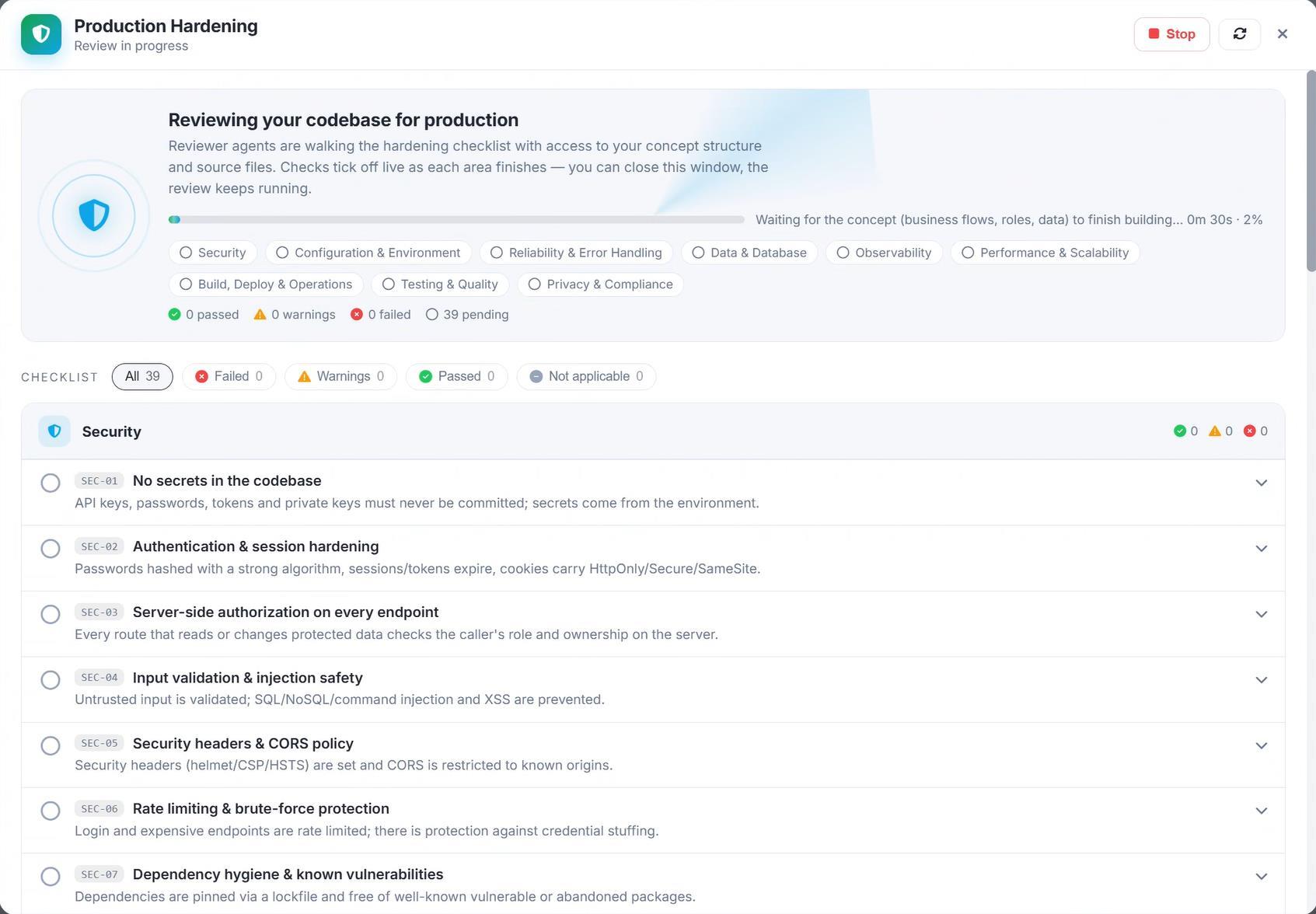
- Assess. One reviewer agent per pillar reads the concept, the file tree and the relevant source files, and works through that pillar's checks. The review is a static reading of the code; it does not build or run the application.
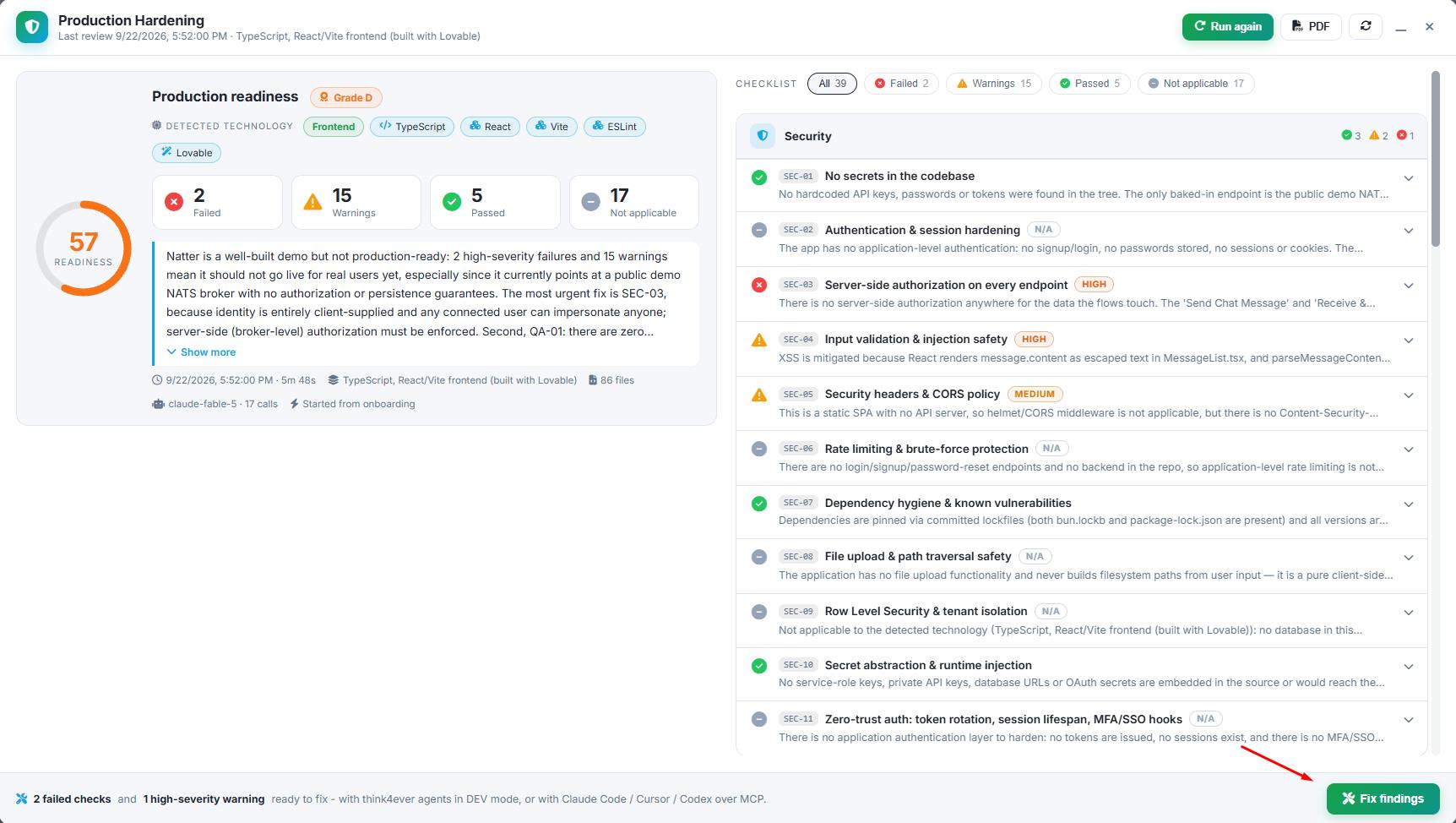
- Score. Each check is Passed, Warning, Failed or Not applicable, with a severity and cited evidence. The Production Readiness Score is the share of applicable checks that pass, with a warning counting as half, graded A to E.
- Remediate. Findings go either to Think4Ever's developer agent, which lists every planned file change and writes nothing until the user confirms, or, as a ready-made fix request over MCP, to Claude Code, Cursor or Codex.
- Re-run. Every run is stored with its score and verdicts. Re-running from the app, the REST API or MCP after each round of changes catches regressions before release.
Because reviewers understand which flows handle which data and which roles should reach them, they can judge whether authorization is actually enforced where it matters, not just whether an auth library is present.
In Practice
Natter, a Lovable-built React messaging frontend (86 files, reviewed in under six minutes), scored 57 (Grade D). Its most urgent finding: identity is entirely client-supplied and the app uses a public message broker with no authorization, so any user can impersonate another. The app has no database, so a scan focused on RLS and database configuration would have nothing to flag.
A Flask and Astro service built outside any vibe coding platform scored 39 (Grade E), with missing security headers and no rate limiting. For a Rust key-management service, the developer agent's plan added per-tenant authentication, input validation and environment-driven configuration, and made the service refuse to run without TLS or authentication.
Where Think4Ever Fits
| Approach | Strength | Limit |
|---|---|---|
| Platform scanners | Automatic security checks at publish time | One platform's stack; security only |
| Security scanners | Broad vulnerability, secret and dependency detection | Pattern-based; no operational pillars |
| Coding agents | Can make almost any fix | No standard checklist or evidence trail |
| Manual audits | Expert architectural judgment | Slow, costly, point-in-time |
| Think4Ever | System-aware nine-pillar review with cited evidence, approved fixes, MCP hand-off, re-runs via app, API or MCP | Complements pentests and formal audits |
A practical sequence: run the builder's own security scan, harden with Think4Ever, re-run the review before each release, and validate with a penetration test before a major release.
Evidence, not certification
The report documents what was checked, what was found and when, and several checks cover controls that SOC 2 and GDPR reviews examine, such as audit trails, server-side access control and personal-data handling.
That makes it useful for security teams, auditors and investors. It is not a certification: SOC 2 is an independent auditor's attestation about an organization, which no tool can confer.
Data handling
The review reads only the copy of the code in the project's Think4Ever workspace. The whole repository is never sent to the model: each reviewer sees the concept summary, the file tree and a bounded set of files, with .env values redacted. Access over the API and MCP requires scoped tokens that can be limited to specific projects.
Conclusion
AI builders have made the first version of an application fast. Think4Ever Production Hardening makes the step to production safe and repeatable across every tool a team uses, so teams keep the speed of AI-assisted development while shipping software they can stand behind.
Learn more
The full checklist, scoring details, fix options, API access and data handling are described in the Production Hardening documentation: https://think4ever.com/docs/manual_production_hardening.html