
White Paper: Think Design - Redefining the AI Coding Harness for Enterprise Software Development
Executive Summary
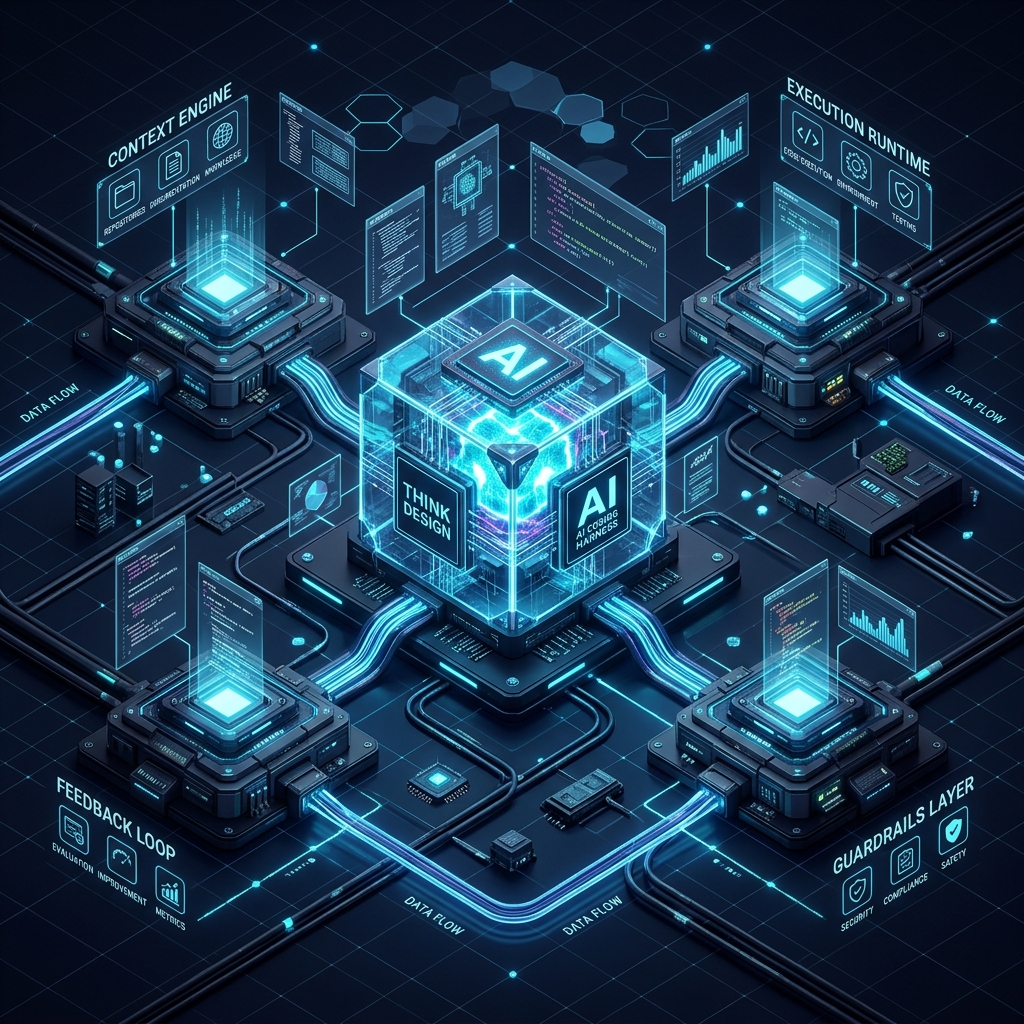
The emergence of AI-driven software development has shifted the bottleneck of software engineering from manual syntax writing to context management and verification. To guide Large Language Models (LLMs) through software engineering tasks, modern developer workflows rely on a coding harness—the scaffolding of tools, context, constraints, and runtime loops that surround an AI agent.
However, current coding harnesses suffer from a fundamental design flaw: they are code-centric. By driving agents to directly manipulate files and react to post-hoc compiler or test errors, existing harnesses foster architectural drift, high token waste, and brittle codebases ("spaghetti at scale").
This white paper defines the structural elements of a modern coding harness, details the architectural limits of current approaches, and presents Think Design as a superior coding harness paradigm—one that grounds agentic execution in design contracts, system architecture, and explicit specifications before a single line of implementation code is generated.
1. Defining the Coding Harness
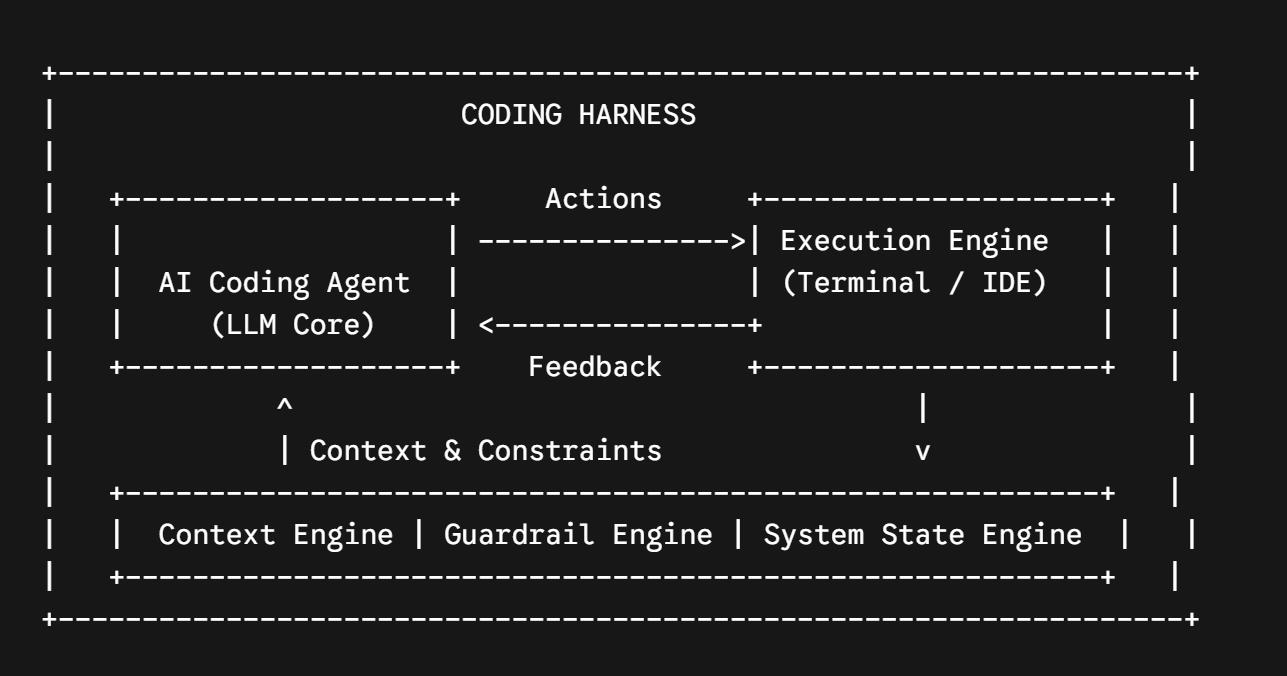
A coding harness is the system architecture, tool integration layer, and runtime control loop that encapsulates an AI coding agent. Rather than exposing an LLM directly to a raw codebase, a coding harness acts as an intermediary environment that feeds the agent relevant information, restricts its actions, executes its commands, and returns feedback.
Core Elements of a Coding Harness
A complete coding harness consists of four key pillars:
1. Context Engine
Retrieves, prunes, and presents relevant repo state to the agent within token limits.
Abstract Syntax Tree (AST) symbol indexing, vector search over docs, and dynamic file dependency graphs.
2. Execution Runtime
Provides a sandboxed interface for the agent to manipulate the environment and inspect results.
Headless VS Code environments, Dockerized terminal execution, linter hooks, and automated test runners.
3. Guardrail & Policy Layer
Imposes safety boundaries, linting rules, security checks, and write permissions.
Read-only permissions on core infrastructure files, static analysis scanners (e.g., SonarQube), and secret leak detectors.
4. Feedback Loop
Formats runtime outputs, failure logs, and diff results into actionable prompt updates for the agent.
Parsing stack traces into structured JSON, capturing runtime console outputs, and feeding linter errors back to the agent for self-correction.
| Component | Function | Concrete Example |
|---|---|---|
| 1. Context Engine | Retrieves, prunes, and presents relevant repo state to the agent within token limits. | Abstract Syntax Tree (AST) symbol indexing, vector search over docs, and dynamic file dependency graphs. |
| 2. Execution Runtime | Provides a sandboxed interface for the agent to manipulate the environment and inspect results. | Headless VS Code environments, Dockerized terminal execution, linter hooks, and automated test runners. |
| 3. Guardrail & Policy Layer | Imposes safety boundaries, linting rules, security checks, and write permissions. | Read-only permissions on core infrastructure files, static analysis scanners (e.g., SonarQube), and secret leak detectors. |
| 4. Feedback Loop | Formats runtime outputs, failure logs, and diff results into actionable prompt updates for the agent. | Parsing stack traces into structured JSON, capturing runtime console outputs, and feeding linter errors back to the agent for self-correction. |
2. The Failure Modes of Current Coding Harnesses
While current coding harnesses enable rapid prototyping ("vibe coding"), they break down when applied to complex, multi-component enterprise systems.
A. The "Code-First" Reactive Loop
Existing harnesses operate reactively:
When an agent is instructed to implement a feature, the harness immediately pushes the agent into file editing mode. If the generated code breaks a unit test or compiler check, the harness feeds the error log back to the agent. This forces the agent into a trial-and-error patching loop, resolving localized bugs by adding incremental code without verifying if the underlying approach aligns with system architecture.
B. Context Rot and Architectural Drift
Because context windows are finite, coding harnesses rely on semantic search (RAG) or file snippets to supply context. As an agent edits multiple files, the broader system intent fades from its context window. Over long multi-turn sessions:
- Abstractions break down: The agent re-implements existing utility functions.
- Contracts degrade: API payloads and database schemas drift away from established patterns.
- Technical debt accumulates: The agent fixes symptoms rather than root architectural causes.
C. High Token Cost & Infinite Correction Loops
In a code-centric harness, catching a design mistake late in the execution pipeline requires the agent to rewrite dozens of files, rerun test suites, and consume hundreds of thousands of tokens. In worst-case scenarios, the agent gets caught in non-deterministic loops, fixing one test while breaking two others.
The Core Problem
Current coding harnesses test whether code runs, but they cannot verify whether the code was designed correctly for the system context.
3. The "Think Design" Harness Architecture
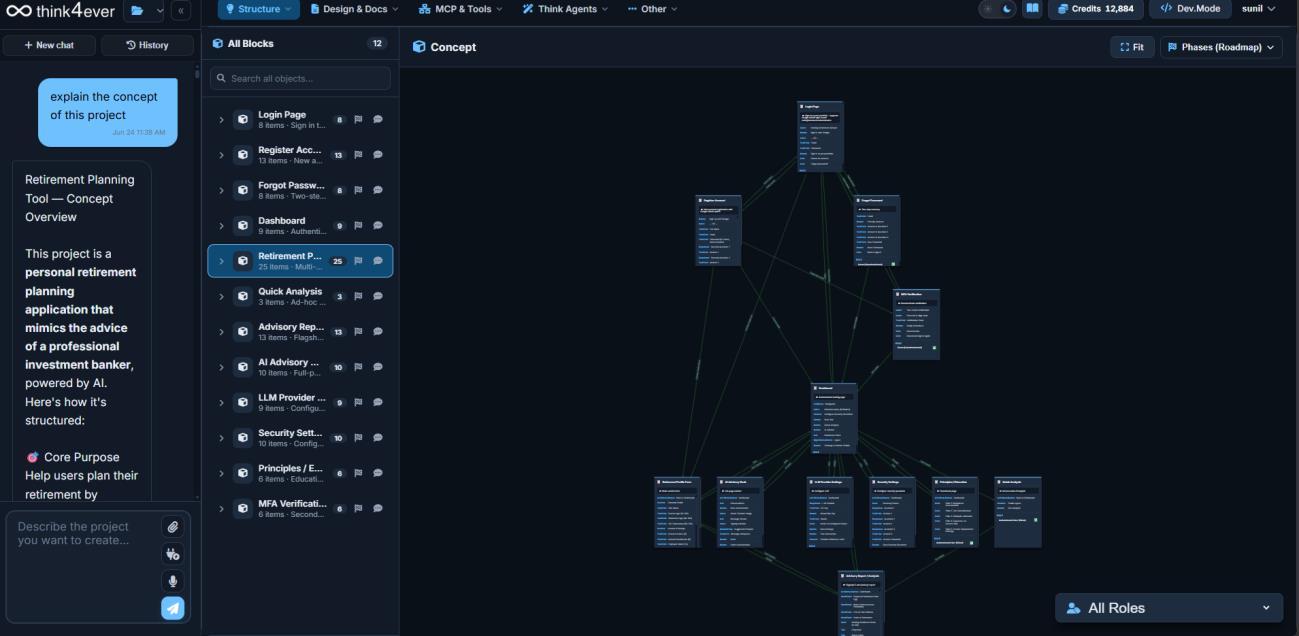
The Think Design First paradigm fundamentally restructures the AI coding harness. Instead of treating raw code as the primary substrate for agent interaction, it introduces an explicit Design Contract & Specification Layer as the primary control plane of the harness.
Pillars of a "Think Design" Harness
1. Pre-Flight Architectural Verification
Before allowing the agent to edit application source files, the harness demands and validates a structured design specification. This includes:
- Interface Contracts: OpenAPI/JSON schemas, GraphQL types, or gRPC definitions.
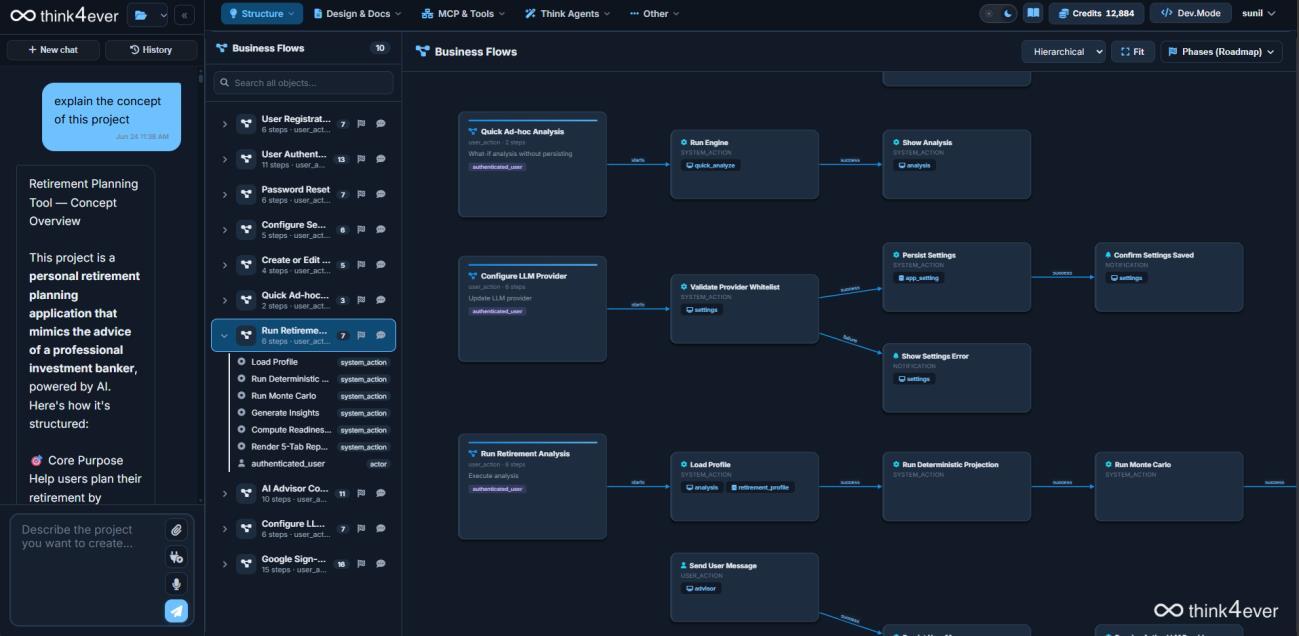
- State & Data Flow Diagrams: Entity-relationship models and explicit state machine maps.
- System Component Boundaries: Clear declaration of modified files, added dependencies, and side effects.
The harness validates this specification before any code generation occurs. If the proposed design violates system constraints, the harness rejects the specification at zero code-generation cost.
2. Design-Level Guardrails (Contract Enforcers)
Instead of relying solely on post-compilation linters, a Think Design First harness evaluates code changes against the pre-approved design contract.
If the agent attempts to modify an unapproved file or break an established API schema, the harness intercepts the operation immediately at the design constraint level, preventing architectural drift.
3. Bilateral Self-Correction
When an error occurs in a traditional harness, the assumption is always "the code is wrong." In a Think Design First harness, error feedback prompts a two-dimensional evaluation:
- Implementation Error: Did the code fail to implement the approved design contract?
- Specification Error: Did unexpected runtime behavior reveal a flaw in the original design specification?
By separating design intent from code execution, the harness can update the design specification first and then cleanly re-generate or refactor the implementation, avoiding patch-upon-patch anti-patterns.
4. Comparative Evaluation
The structural differences between traditional code-centric harnesses and the Think Design First paradigm:
Primary Interaction Substrate
Raw Source Code (.ts, .py, .go)
Design Specifications, Schemas, & System Contracts
Validation Phase
Post-Execution (Compiler errors, test failures)
Pre-Execution (Design validation) & Post-Execution
Architectural Coherence
Low (Degrades over multi-file edits)
High (Anchored to explicit system specifications)
Refactoring Efficiency
Poor (Requires parsing and editing large code diffs)
Excellent (Updates design contracts, propagating clean edits)
Token Efficiency
Low (High iteration loops over long code blocks)
High (Compact design models reduce code-generation iterations)
Enterprise Readiness
Prototyping & isolated script generation
Multi-service, full-stack, enterprise application development
| Feature | Code-Centric Harness (Traditional) | "Think Design First" Harness |
|---|---|---|
| Primary Interaction Substrate | Raw Source Code (.ts, .py, .go) | Design Specifications, Schemas, & System Contracts |
| Validation Phase | Post-Execution (Compiler errors, test failures) | Pre-Execution (Design validation) & Post-Execution |
| Architectural Coherence | Low (Degrades over multi-file edits) | High (Anchored to explicit system specifications) |
| Refactoring Efficiency | Poor (Requires parsing and editing large code diffs) | Excellent (Updates design contracts, propagating clean edits) |
| Token Efficiency | Low (High iteration loops over long code blocks) | High (Compact design models reduce code-generation iterations) |
| Enterprise Readiness | Prototyping & isolated script generation | Multi-service, full-stack, enterprise application development |
5. Conclusion
As AI coding models increase in reasoning capacity, the primary bottleneck in automated software engineering is no longer code generation speed—it is architectural fidelity and systems control.
Traditional, code-centric harnesses trap AI agents in reactive trial-and-error loops that lead to brittle systems and high maintenance overhead. The Think Design coding harness elevates the primary unit of AI collaboration from lines of syntax to architectural intent.
By enforcing design validation, contract-driven guardrails, and structured system planning prior to code execution, Think Design provides the necessary foundation for scalable, deterministic, and enterprise-ready agentic software development.
Additional Resources
Documentation
- Think Designer: Think Design Mode focuses on upfront planning and blueprint mapping. Here, you interact with the AI to refine requirements, map out relational data objects, build business flows, define user roles, and establish integration maps. It acts as the structural brain of your system, ensuring your design is sound before any codebase files are generated.
Related Blogs
- Architecture-first agentic development with Think4Ever™: As AI coding agents become ubiquitous, the bottleneck in software development has shifted from writing syntax to maintaining architectural integrity. Most current "Code-First" assistants excel at generating localized boilerplate but often fail to maintain global system coherence, leading to "architectural drift" and technical debt. Think4Ever addresses this by introducing a "Design-First" agentic protocol that formalizes system architecture, data contracts, and service boundaries before a single line of code is committed.