
Architecture-first agentic development with Think4Ever™

Executive Summary
As AI coding agents become ubiquitous, the bottleneck in software development has shifted from writing syntax to maintaining architectural integrity. Most current "Code-First" assistants excel at generating localized boilerplate but often fail to maintain global system coherence, leading to "architectural drift" and technical debt. Think4Ever addresses this by introducing a "Design-First" agentic protocol that formalizes system architecture, data contracts, and service boundaries before a single line of code is committed.
The Problem: The "Code-First" Collapse
Current market leaders like Claude Code and Cursor operate on a high-context, iterative loop that typically focuses on immediate file-level implementation. This leads to several systemic failures:
- Incremental Entropy: Without a rigid architectural blueprint, agents introduce competing schemas or leaky abstractions in large codebases.
- Contextual Fragmentation: Agents can "hallucinate" architectural consistency, making local optimizations that are globally destructive over time.
- The Black Box Trap: You lose control of your own code as the gap between AI actions and human understanding grows. One-dimensional communication via a chat window turns your codebase into a "black box" where agents fix one thing only to break another.
- The Feedback Loop of Rot: AI-generated "messy" code is accepted because it works, which then becomes the project's "standard style" for the AI, causing the signal-to-noise ratio in the context window to collapse.
Think4Ever Approach: Architecture as the Primary Artifact
Think4Ever flips the traditional AI development lifecycle by treating the System Design Document (SDD) and Architectural Decision Records (ADR) as the "Source of Truth" rather than the existing codebase.
Key Pillars of the Design-First Protocol:
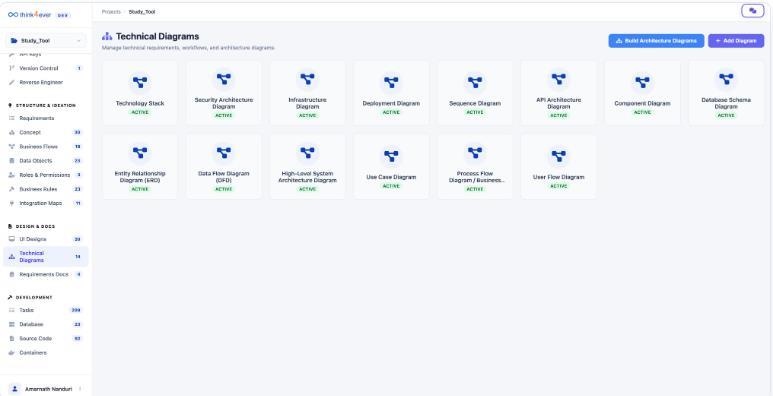
- The Architect Agent: Deploys a high-reasoning agent to map service boundaries, C4 model diagrams, and API contracts before coding begins.
- Formalized Contracts & Linting: The platform enforces strict data ownership; all generated code must pass an "Architectural Linter" that validates it against the initial design.
- Human-Agent Collaboration: Human leads are always in the loop, designing alongside agents through visual planning and joint decisions at every stage—concept, business flows, and technical design.
- Constraint-Based Generation: Agents are tasked with implementing specific design components within established architectural constraints rather than just "building a feature".
Role-Specific Excellence: Code is Not Everyone's Job
The industry currently forces all stakeholders to interact with projects through coding agents. Think4Ever recognizes that professionals should own their specific domains:
- System-First Focus: Project managers, business analysts, and UI designers care about what the system does, not what the code does. The code should follow the system, not the other way around.
- Expertise-Led Contribution: Each discipline contributes where they are strongest. When code drifts from design, developer agents are used specifically to bring the implementation back in line with the architectural vision.
- The System as a Connector: The system handles coordination, aligning disparate roles and disciplines toward a final, stable result without forcing anyone out of their professional expertise.
Technical Implementation & Workflow
- Discovery Phase: The user provides high-level intent. Think4Ever generates comprehensive designs including concepts, functional/technical specs, DB design, ERDs, workflows, personas, and integration maps.
- Review & Locking: The human lead reviews and "locks" the architecture.
- Targeted Execution: Sub-agents build individual components based on predefined "rules of the world," resulting in consistent, bug-free code.
- Verification: Automated testing ensures implementation strictly matches the architectural contract.
Why Architecture is the "New Compiler"
In 2026, code is cheap, but maintenance is expensive.
New Feature
01"I'll just add this function here..."
"Does this fit the System Map?"
Tech Debt
02Compounds with every prompt.
Prevented by "Design Guardrails".
Onboarding
03Read 100 files to understand the app.
Read 1 System Design Doc.
Refactoring
04Nightmare; everything is tangled.
Easy; boundaries are clearly defined.
| Problem | Code-First Result (Cursor/Claude) | Design-First Result (Think4Ever) |
|---|---|---|
| New Feature | "I'll just add this function here..." | "Does this fit the System Map?" |
| Tech Debt | Compounds with every prompt. | Prevented by "Design Guardrails". |
| Onboarding | Read 100 files to understand the app. | Read 1 System Design Doc. |
| Refactoring | Nightmare; everything is tangled. | Easy; boundaries are clearly defined. |
Summary
The future of agentic development is not about speed, but about maintaining stable systems. By moving the "thinking" to the architecture layer, Think4Ever enables teams to build complex, enterprise-grade applications that are resilient to the chaos of automated code generation.
Related reading: Discover the five critical views for understanding dependencies before making a change, ensuring architectural integrity is never compromised.