
One Spec, Every Agent: Unifying the Agentic Developer Ecosystem via Think4Ever and MCP
Executive Summary
The rapid proliferation of AI coding assistants has ushered in an era of unprecedented, localized execution speed. Today, software engineering teams are no longer bound to a single tool; developers routinely cycle between specialized clients—such as Claude Code, Cursor, and Replit—depending on their immediate workflow needs or individual preferences. However, this fragmented tool landscape exposes a critical structural flaw in modern software development: ephemeral context window volatility.
Because traditional AI assistants rely entirely on short-lived session context, system understanding degrades with every closed tab, cleared history, or model transition. This localized blindness accelerates architectural drift, creates conflicting database schemas, and breaks system-wide consistency across distributed teams.
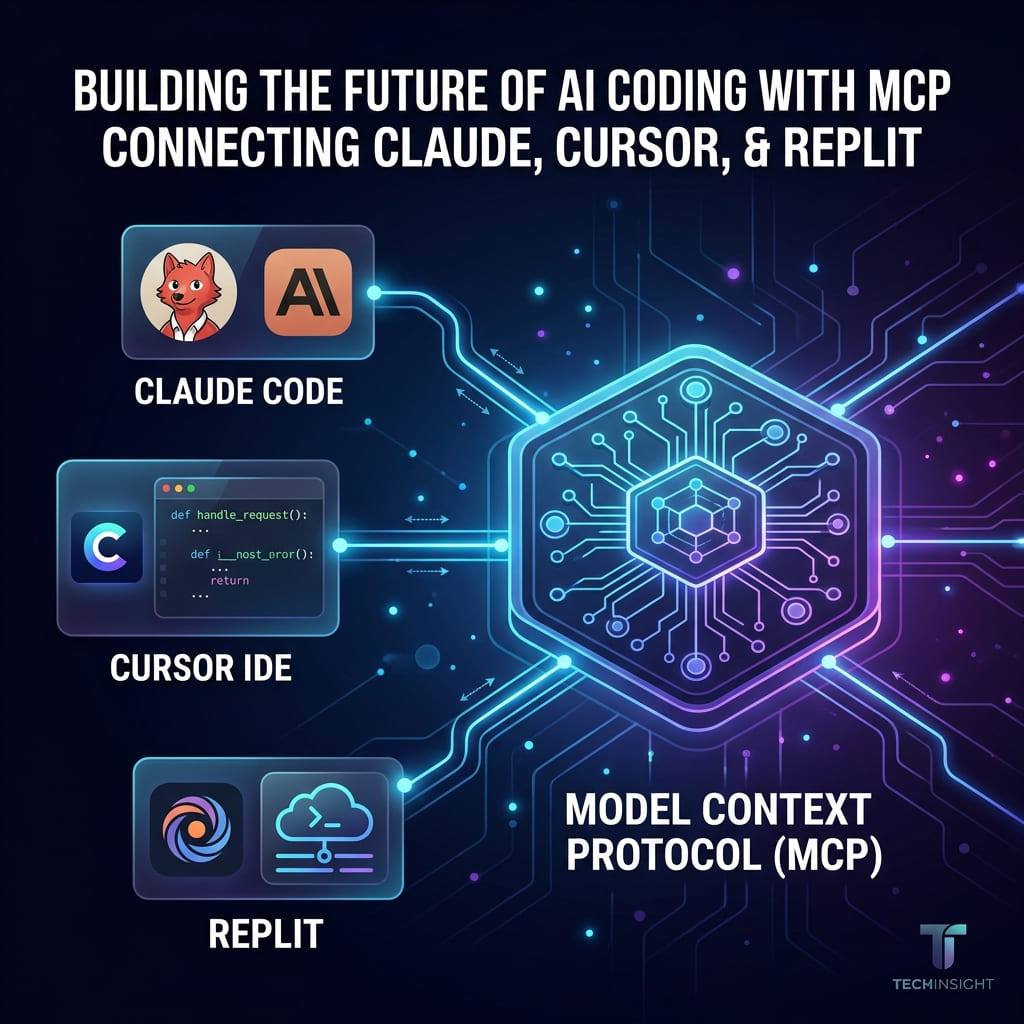
Think4Ever solves this architectural collapse by acting as a persistent, machine-readable "product brain." Rather than storing system specifications in loose prompts or static documentation, Think4Ever codifies the entire system design into an unyielding structural blueprint. By exposing this unified specification to any external coding engine via the open-source Model Context Protocol (MCP), Think4Ever shifts the industry paradigm from fragmented, conversation-bound coding to centralized, architecture-first engineering. Whichever client your team prefers, they all build from a single, indestructible source of truth: One Spec, Every Agent.
The Core Volatility: The Ephemeral Context Problem
The modern AI development stack treats the codebase and the immediate chat history as the primary source of truth. This approach inherently caps the efficiency of engineering teams due to three structural vulnerabilities:
- Context Decay and Session Bound Expiration: AI coding engines are only as good as the context fed into their active windows. Once a development session ends, that context dies. The next session requires re-prompting or forces the agent to blindly ingest hundreds of local repository files, discarding the strategic decisions made hours prior.
- The "N×M" Integration Crisis: As teams adopt varied developer clients (e.g., Engineer A uses Cursor, Engineer B uses Claude Code on the command line, and Engineer C leverages automated CI/CD sub-agents), coordinating system intent becomes an operational nightmare. Without a unified abstraction layer, each tool forms its own disconnected mental model of the product.
- Prompt Engineering Entropy: Relying on human developers to repeatedly paste, update, and retype design guidelines into separate assistant interfaces invites configuration drift. Minor variations in how design contracts or business rules are communicated to different models lead to divergent, incompatible codebases.
The Architectural Solution: Think4Ever as an MCP Gateway
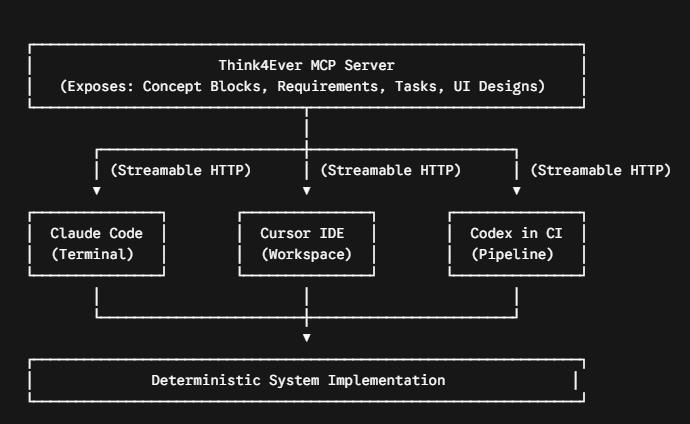
The Model Context Protocol (MCP), an open standard pioneered to connect large language models securely to external data services, provides the ideal infrastructure to eliminate context isolation. Think4Ever leverages MCP to position itself as a centralized, queryable architectural server sitting directly underneath your team's preferred AI clients. Instead of passing massive, token-heavy raw documents through individual prompt boxes, Think4Ever wraps structural specifications into semantic, machine-readable data endpoints. When a coding agent connects to Think4Ever over MCP, it does not invent an architecture; it queries a permanent, multi-role blueprint that governs the life cycle of the system.
The Structural Anatomy of the Permanent Product Blueprint
To enable deterministic, multi-agent development, Think4Ever formalizes product definitions into an interconnected, queryable structure rather than vague text prompts. The platform maintains six distinct layers:
- Concept & Design Contract: Establishes core system vocabulary, structural style properties, and global component behaviors.
- User Flows & Named Business Rules: Maps functional paths with explicit backend guardrails (e.g.,
rule_prevent_double_booking) that can be validated dynamically. - The Unified Data Model: Tracks cross-entity relations, absolute schemas, data types, cardinalities, and internal sensitive-field flags.
- Deterministic API Contracts: Exposes concrete endpoints alongside strict request/response JSON examples, eliminating structural guessing games.
- UI Component Designs: Houses pre-materialized layout data, structural styling tokens, and accessible element states.
- Roles & Access Control Matrices: Governs permission boundaries, role-based screen visibilities (roleAccess), and service-level constraints.
Why Connect a Client: Six Practical Benefits
By separating the architectural thinking layer from the coding layer, Think4Ever changes how development tools interact with a system. Instead of generating behavior from incomplete local context, connected agents implement against a defined and durable model.
I. One Spec, Every Agent
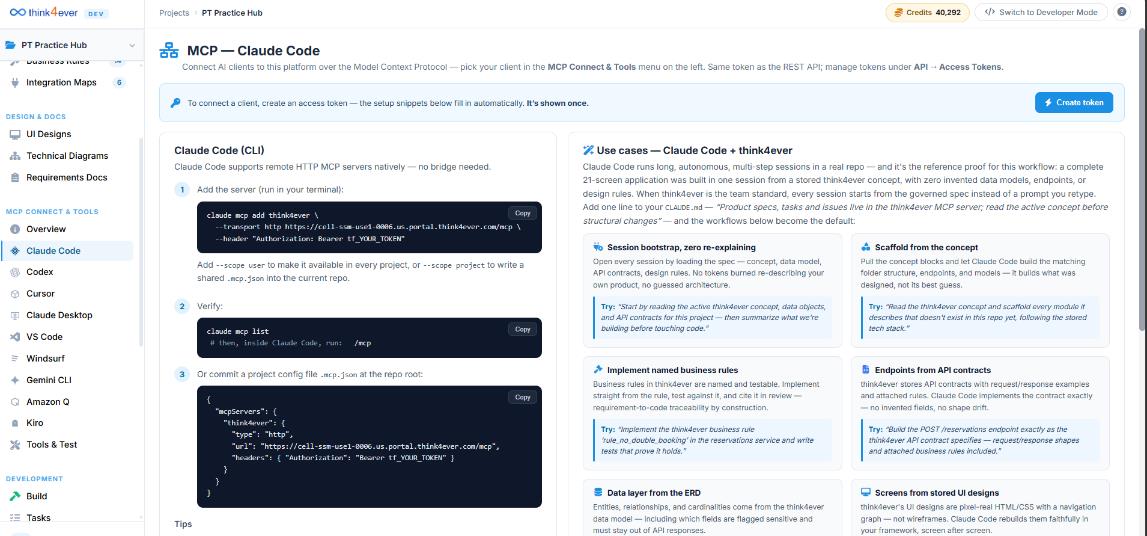
Coding agents are completely limited by their context window. Think4Ever stores the product blueprint as a permanent, machine-readable structure encompassing concepts, design contracts, user flows, named business rules, ERDs, API contracts, UI designs, and roles/access matrixes. Because every tool in the environment connects to that exact spec over MCP, tool lock-in is broken.
"Read the active think4ever concept before doing anything else, and treat it as the source of truth for this session."
II. Stop Re-explaining Your Product
Developers no longer burn the first 20 minutes of every coding session re-describing data models, endpoints, or design rules to their chat assistants. The client fetches these parameters programmatically on startup.
"Load my project context from think4ever — concept, data objects, api contracts, and design rules — instead of asking me to describe it."
III. One Task Board, Everywhere
The task lifecycle is fully democratized across tools. Sub-agents can list, pick up, update, and close project tasks natively from inside any connected interface, keeping team status perfectly synchronized regardless of whether a developer is working inside a terminal or a visual IDE workspace.
"List my open think4ever tasks and start the highest-priority one."
IV. Issues Filed at the Source
When local test suites fail or runtime bugs appear mid-session, the executing agent directly pings the MCP gateway to file an issue block equipped with complete architectural context, preventing debugging logs from evaporating when the immediate chat finishes.
"Create a think4ever issue for this failing test with the stack trace and your root-cause analysis."
V. Specs That Never Go Stale
When an engineer executes a structural refactor, the agent doesn't just update the local files—it updates the underlying blueprints inside Think4Ever, ensuring documentation natively tracks code changes dynamically.
"I split the billing module in two — update the think4ever concept and requirements to match."
VI. Switch Vendors, Keep Everything
Product knowledge remains localized inside Think4Ever instead of being fragmented across disjointed vendor chat history logs. Engineering teams can swap out their agent stack mid-project without losing context momentum.
"You're new to this project — read everything in think4ever and continue where the previous agent stopped."
Multi-Agent Workflows in Practice
By decoupling design from execution, team members are empowered to choose the front-end execution agent that fits their personal developer workflow without risking codebase fracture.
- The UI Prototype Specialist (Using Cursor): A front-end designer launches Cursor and instructs it to build user views. Cursor queries the Think4Ever MCP server to grab the exact component specifications, layout tokens, and screen hierarchies.
- The Backend Architect (Using Claude Code): Simultaneously, a backend engineer opens Claude Code in the terminal to scaffold microservices. Instead of making safe assumptions about data types, Claude Code calls the MCP schema engine to extract database mappings and named business rules directly.
- The Automated Pipeline (Using Custom CI Sub-Agents): During continuous integration, automated checking agents ping the same MCP endpoint to verify that recent pull requests strictly fulfill the defined architecture.
Session Logs: Real-World Multi-Client Invocations
To understand the practical impact of this architecture, consider the following simulated session logs showing how different developer tools communicate with the underlying Think4Ever MCP engine to build the same application without losing context:
Developer Environment A: Terminal Interface via Claude Code
$ claude-code "Scaffold out our room checking and reservation microservices."
"Connecting to Think4Ever via Model Context Protocol... Exchanging handshake... Ready."
"Invoking think4ever.get_data_model() to inspect database constraints..."
"Retrieved: ERD with 23 entities. Explicitly preserving structural rule: stay 1:1 folio and detecting sensitive-field flags on financial attributes."
"Invoking think4ever.get_business_rules() to extract validation barriers..."
"Enforcing backend logic constraint: rule_room_clean_for_checkin. Writing microservice handlers strictly bound to these specifications. I am executing a defined schema, not inventing one."
Developer Environment B: IDE Workspace via Cursor
AI Chat: @think4ever-mcp Generate the frontend administration screens for our operational dashboard.
"Querying Think4Ever MCP Server: think4ever.get_ui_screens(module: 'admin')..."
"Successfully parsed 21 fully structured layout definitions containing pre-mapped dataRefs and flowRefs."
"Applying system design constraints: Fetching global semantic color palettes (mapping state.dirty directly to warning styles, state.out_of_order to error components)."
"Materializing user interfaces locally. Navigation boundaries, color hierarchies, and asset access roles correspond exactly to the data model built by Claude Code in the terminal session."
6. Comparative Paradigm Matrix
Context Longevity
01Ephemeral; expires or degrades as soon as a conversation session is reset.
Permanent; cached machine-readable state survives across tools and days.
Cross-Tool Interoperability
02Non-existent; Claude Code, Cursor, and Replit remain isolated context islands.
Complete; all clients call the same foundational MCP endpoints simultaneously.
Architectural Enforcement
03Vulnerable to hallucination; agents write plausible code that violates global systems.
Guaranteed via automated linting against machine-readable JSON specifications.
Token Consumption Efficiency
04Extremely low; requires repeatedly pasting large code context files or rules.
Extremely high; filters, structures, and progressive disclosure fetch data only on-demand.
Developer Autonomy
05Total tool lockdown; entire teams must use the identical agent to keep context aligned.
Total freedom; developers choose their favorite tool; the underlying model ensures parity.
| Strategic Development Metric | Fragmented, Conversation-Bound Agents (Code-First) | Unified Think4Ever MCP Architecture (Design-First) |
|---|---|---|
| Context Longevity | Ephemeral; expires or degrades as soon as a conversation session is reset. | Permanent; cached machine-readable state survives across tools and days. |
| Cross-Tool Interoperability | Non-existent; Claude Code, Cursor, and Replit remain isolated context islands. | Complete; all clients call the same foundational MCP endpoints simultaneously. |
| Architectural Enforcement | Vulnerable to hallucination; agents write plausible code that violates global systems. | Guaranteed via automated linting against machine-readable JSON specifications. |
| Token Consumption Efficiency | Extremely low; requires repeatedly pasting large code context files or rules. | Extremely high; filters, structures, and progressive disclosure fetch data only on-demand. |
| Developer Autonomy | Total tool lockdown; entire teams must use the identical agent to keep context aligned. | Total freedom; developers choose their favorite tool; the underlying model ensures parity. |
Conclusion
The engineering teams that thrive in an agent-abundant world will not be those that generate code the fastest, but those that maintain system architecture with the highest discipline. By unifying diverse development tools under a singular, machine-readable specification, Think4Ever transforms the chaos of fragmented AI code generation into a predictable, deterministic assembly line. Connecting your development clients over MCP guarantees that no matter how many agents your team deploys, they are all working towards the exact same goal. The context barrier is permanently broken: One Spec, Every Agent.
Learn More
To explore the platform in more detail, the following Think4Ever resources provide a useful starting point for product information, documentation, and direct contact with the team.
- Get Early Access – Free trial and monthly subscription.
- Think4Ever Homepage – Company overview and platform introduction.
- Documentation – Product documentation and implementation resources.
- FAQ – Answers to common product and platform questions.
- Contact Us – Connect with the Think4Ever team for product inquiries and discussions.