
Whitepaper: Think4Ever MultiModaal Routeren
Strategic Cost Efficiency in Agentic Development
Think4Ever's Multi-Model Orchestration Architecture
Samenvatting
As the agentic application development platform scales to support hundreds of early-access developers and robust enterprise architectures, the decision of how to deploy Large Language Models (LLMs) dictates both platform performance and operational viability. The conventional approach of relying on a single, monolithic model creates inescapable friction: developers are forced into either overpaying for routine tasks or compromising logic quality on complex workflows.
This white paper outlines the economic and technical advantages of Think4Ever's multi-modal routing architecture, demonstrating how task-specific orchestration maximizes platform credit yield and optimizes token economics at scale.
1. The Single-Model Dilemma vs. Task-Specific Routing
A single-model architecture forces a permanent tradeoff in platform engineering. Employing a flagship, high-parameter model for every user interaction results in catastrophic token inflation. Conversely, relying exclusively on a smaller, cost-effective model severely degrades the quality of complex reasoning and code generation tasks.
Think4Ever resolves this via Multi-Model Orchestration, ensuring the cognitive demand of the task dictates the specific model invoked.
Cognitive Alignment in Practice
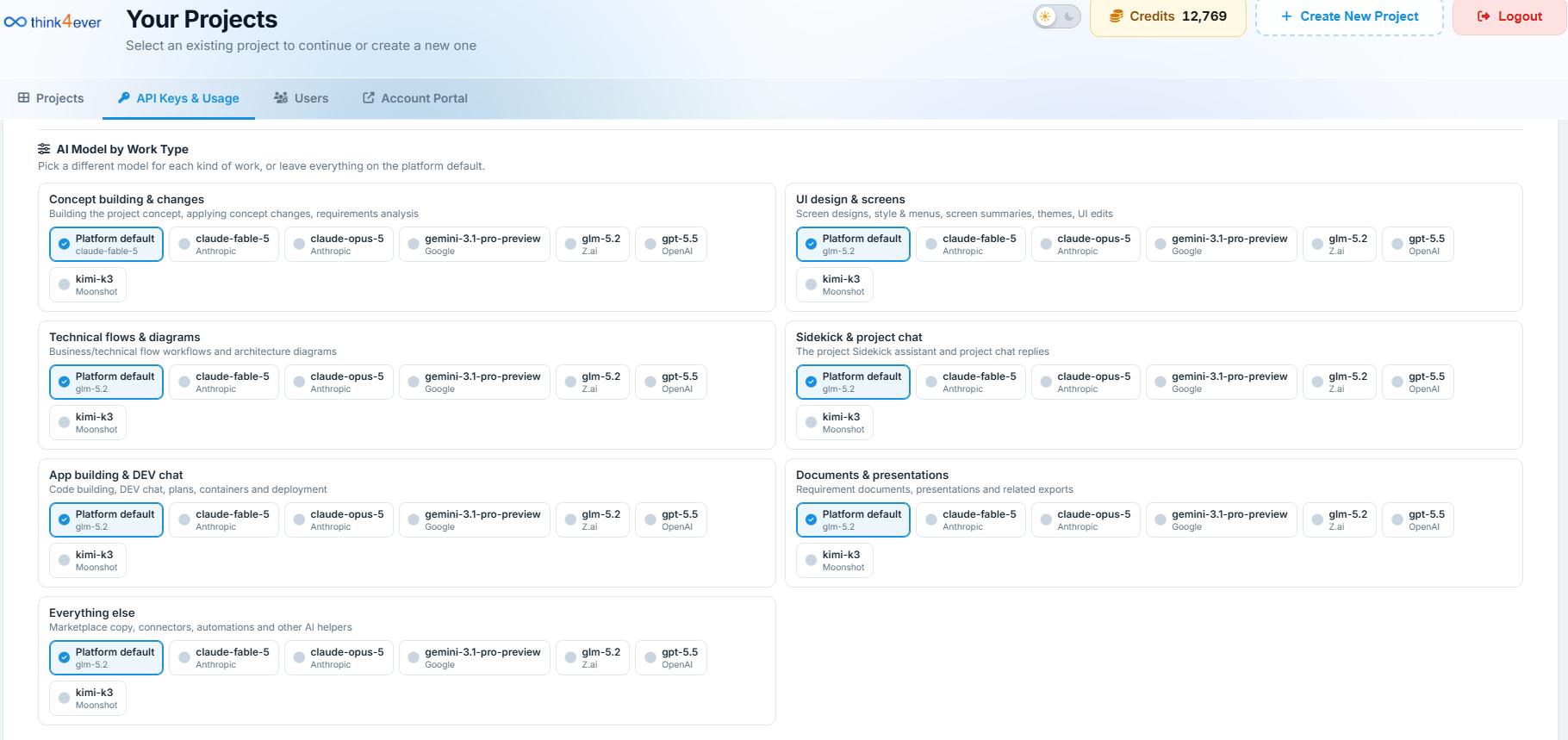
The Think4Ever platform introduces a dynamic routing configuration labeled AI Model by Work Type, allowing platform defaults to intelligently segregate workloads (as well as allows user to override/specify a specific model for a specific work type):
- Routine Processing: High-volume, structurally predictable tasks such as UI design & screens, Documents & presentations, and Sidekick & project chat are automatically routed to highly efficient, rapid-response models (e.g.,
glm-5.2). - Complex Reasoning: Foundational logic requirements and system architecture, such as Concept building & changes, invoke sophisticated reasoning engines (e.g.,
claude-fable-5), providing seamless escalation paths to premium models (e.g.,claude-opus-5orgpt-5.5) solely when the project complexity necessitates it.
2. Managing Token Economics at Scale
Evaluating real-world usage data across active development lifecycles reveals the dramatic impact of model orchestration on daily token consumption. Token loads fluctuate significantly based on the active phase of the project.
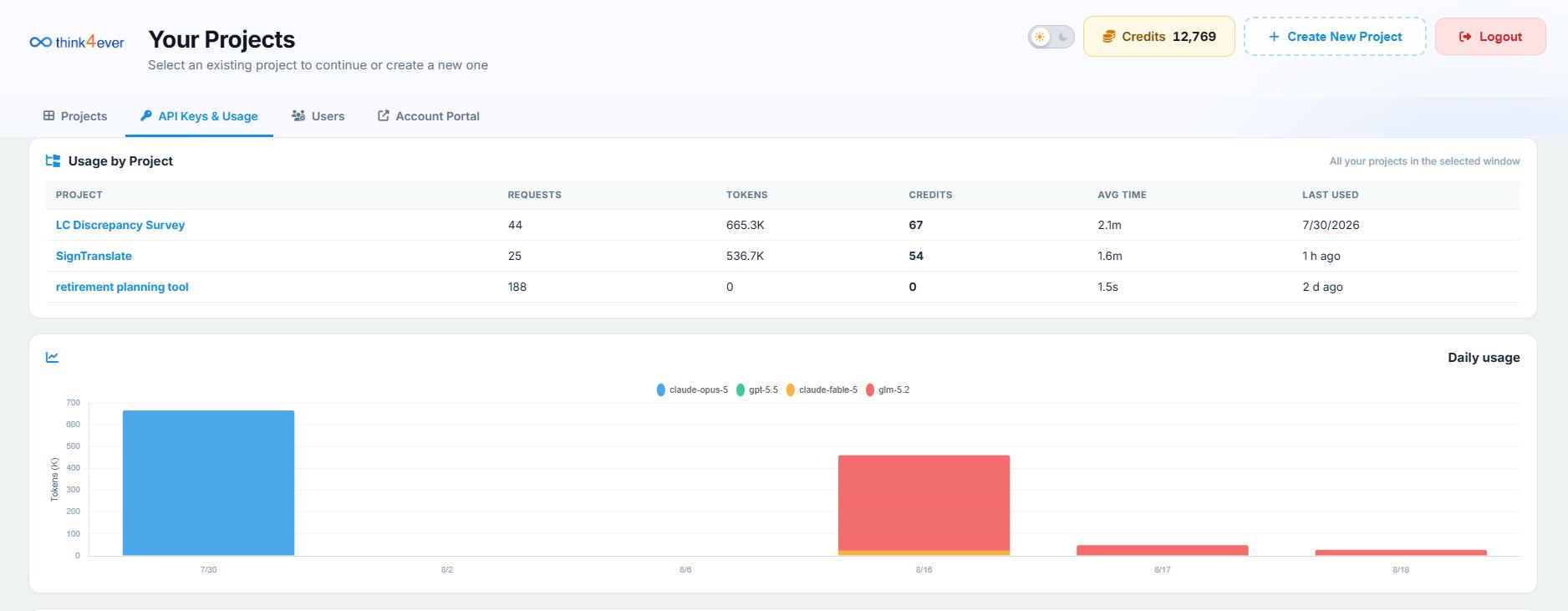
Empirical Observation: During intensive reasoning phases (such as resolving complex logic in the LC Discrepancy Survey project), the system effortlessly processes targeted bursts of over 665,000 tokens utilizing claude-opus-5. However, as the workload transitions to high-volume generation and conversational UI updates, the load seamlessly shifts to glm-5.2, absorbing hundreds of thousands of tokens without triggering premium billing rates.
If the architecture were constrained to a single premium model, high-volume generation phases would rapidly drain account resources. Multi-modal routing ensures that bulk processing remains economically sustainable without sacrificing the availability of elite reasoning capabilities when required.
3. Maximizing Platform Credit Yield
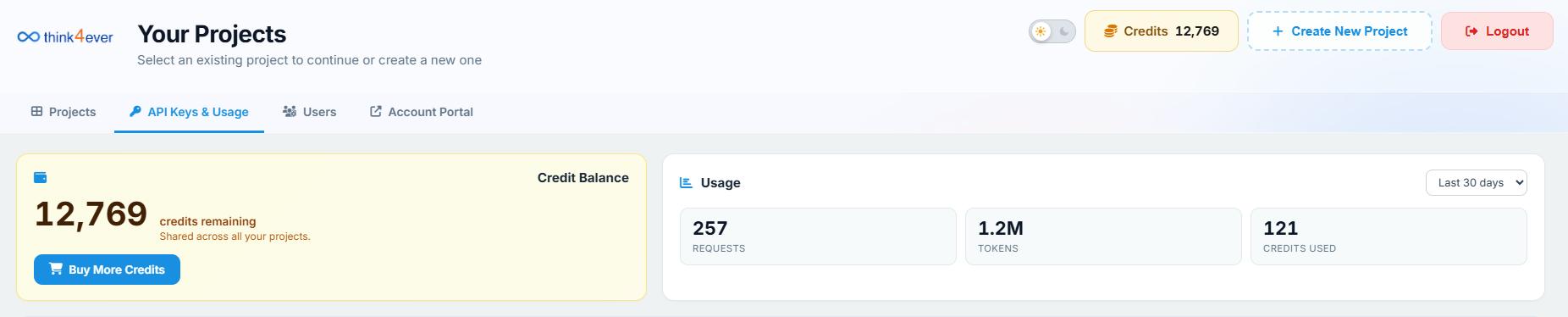
The ultimate metric of platform efficiency is the translation of operational tokens into financial cost. Think4Ever's architecture allows developers to stretch their budgets significantly further while maintaining uncompromising output quality.
1.2M Tokens Processed (30 Days)
257 Total Requests Executed
121 Credits Consumed
By actively mitigating the cost of routine requests, this orchestration achieves an exceptionally low credit-to-token ratio. Generating over a million tokens for a mere 121 credits preserves the vast majority of an account’s credit balance (e.g., 12,769 credits remaining out of a standard balance) for future, extended development cycles.
Conclusion
Think4Ever’s multi-modal routing support is not merely a technical feature; it is a foundational economic strategy for modern platform adoption. By decoupling the complexity of the task from a rigid single-model dependency, the platform delivers elite reasoning exactly where it is needed, while preserving capital everywhere else. For developers building the next generation of agentic applications, this architecture guarantees that product innovation is never bottlenecked by inefficient token economics.
Strategic Architecture Review • Think4Ever Platform